Code, Cameras, and Irony: Rebuilding My Web Stack with AI
06/08/2026
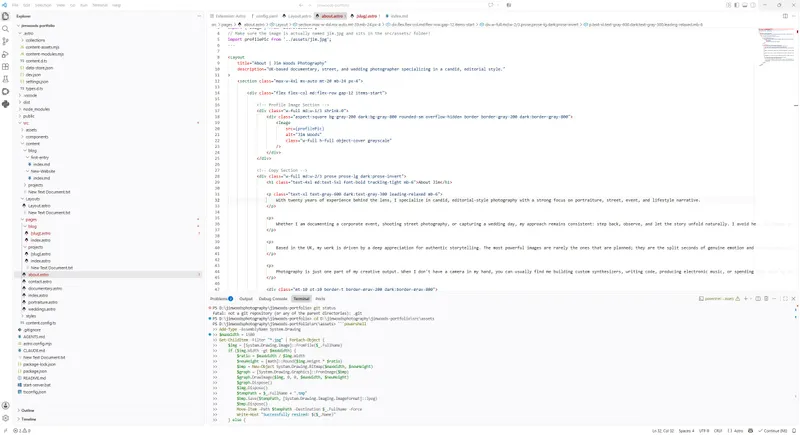
For a long time, my site sat in a comfortable, if somewhat restrictive, holding pattern on Mobirise. It did the job, but it always felt like renting a pre-furnished room: quick to move into, but impossible to knock down a wall when you wanted to stretch out.
I wanted something lean, blindingly fast, and completely custom. A modern Astro build running through VS Code and deploying automatically via Netlify. But bridging the gap between wanting a sophisticated front-end setup and actually writing the underlying architecture line by line is usually where projects go to die in a pile of open browser tabs.
Enter Gemini.
Over the course of a few focused sessions, I used an AI pair-programmer to do the heavy lifting: migrating layouts, wiring up custom content collections, configuring image optimisation pipelines, and troubleshooting setup errors in real time. What would have taken weeks of forum-digging and trial-and-error took a fraction of the time.
And that brings me to the uncomfortable part.
The Creative Paradox
As someone deeply invested in creative pursuits, where authentic observation, genuine emotion, and real-world human connection are everything; I am not blind to the deep skepticism surrounding AI in creative communities.
When generative tools threaten to flood spaces with synthetic imagery, generic copy, and automated art, it is easy to feel defensive. We worry about craft being devalued. We worry about shortcut culture replacing genuine skill. We worry about losing the soul of creative work to algorithmically generated noise.
Those concerns are completely valid. But working through this build highlighted an important distinction for me: there is a fundamental difference between AI as a creative substitute and AI as a technical lever.
Using an LLM didn’t choose the narrative of my work, decide which split-second moments were worth preserving, or define my personal style. What it did do was remove the technical friction between my vision and the screen. It acted as an tireless assistant, a developer sitting next to me explaining error codes, writing boilerplate, and helping me construct a custom engine to host my work without compromising on control or performance.
When used to amplify human intent rather than replace it, the technology ceases to be a threat and becomes an incredible equaliser for solo creators.
The Elephant in the Editor
Of course, I am not immune to the glaring hypocrisy sitting right here in the text.
I am writing a reflection on the tension between artistic craft and artificial intelligence, while leaning on an AI model to help structure, refine, and polish the very prose you are reading.
Is it ironic? Absolutely. But maybe that self-awareness is the point.
We don’t have to reject modern tools to preserve creative integrity, nor do we have to blindly hand over our creative voice to algorithms. The middle ground is where the magic happens: using technology to build the stage, while keeping the human story firmly in the spotlight.